
Nervecited
On third graders, senior year, and being invited into the work of becoming

Nervecited
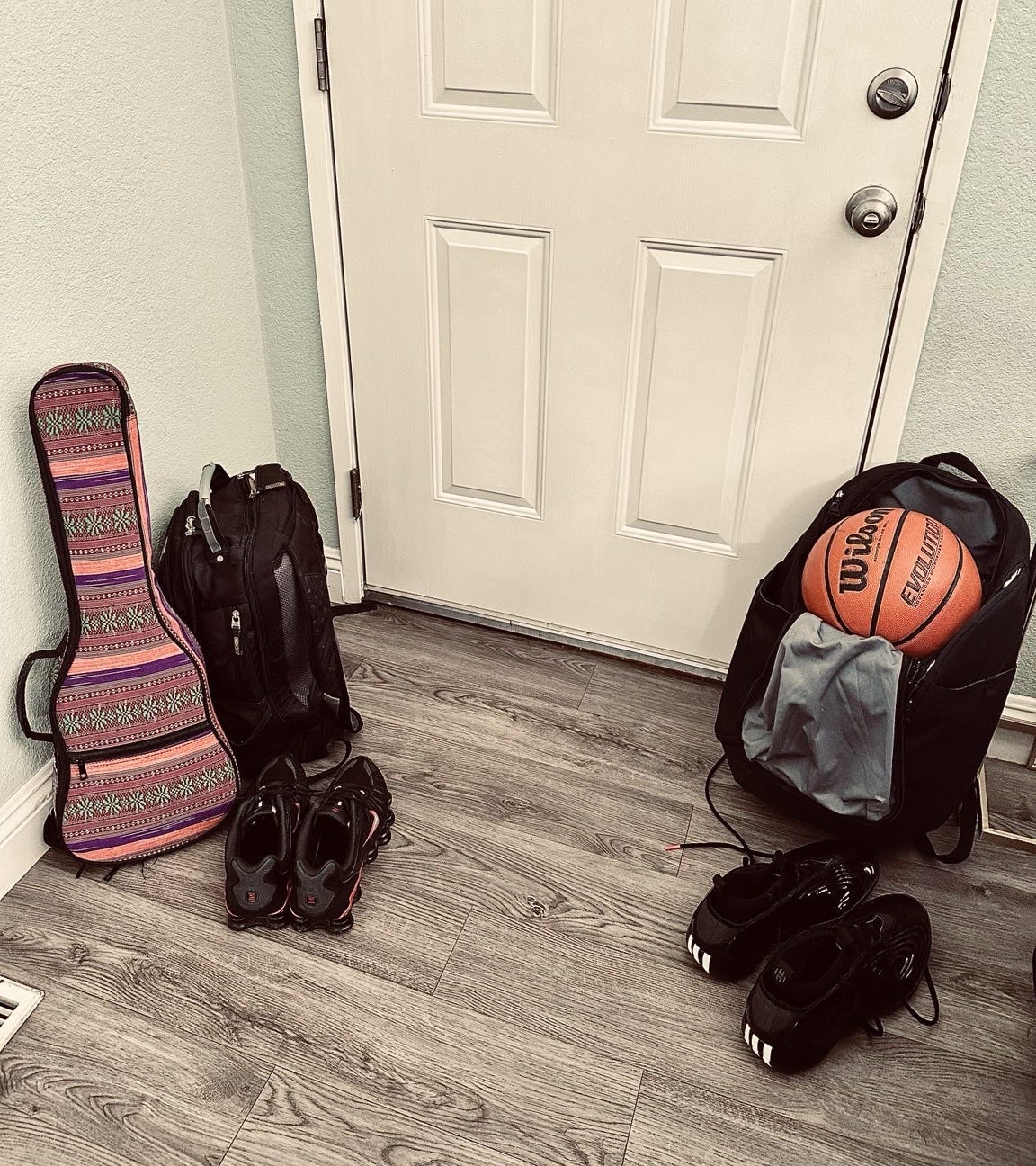
“I’m excited about the schedule you’ll have as a teacher,” my wife said as we walked the dog this morning.
With our oldest going off to college soon, and the second not all that far behind, she is glad I will have time off when they may be coming home. Summer. Thanksgiving. Christmas. Maybe the occasional long weekend.
I had just told her that I was beginning my last week of summer break.
Next week, I have three days of preparation before a classroom of third graders gets me for more than half of their school year, which is an almost immeasurably long time in the mind of a third grader.
Two weeks after that, I will begin school again myself, working toward a California teaching credential. After eight years of graduate education, what is a little more?
The children arriving in my classroom will mostly be eight years old. There is something strange and lovely about the thought that, in our own ways, we will both be eight and still learning what comes next.
They tell me the credential program may require thirty to forty hours of work each week. They tell me that as a long-term substitute I will be grading papers, meeting with parents, attending specialized training, and doing nearly everything a classroom teacher does.
The last university representative I spoke with listed all of this and then said, “And I’m not worried about you at all.”
I am not sure exactly why.
Perhaps he was impressed by how prepared I was for the meeting. Perhaps he was surprised when I told him I already had a master’s degree and a doctorate. Perhaps my ADHD simply did not want to sit through information I had already found for myself, so I kept telling him I knew what he was about to say.
Whatever his reasons, I appreciated the confidence.
Truth be told, I am a little nervous.
This is my son’s senior year of high school, which has somehow arrived as a surprise. I knew it was coming. I understand how calendars work. Still, it seems much too quick.
Most of the time we will ever spend living together has already passed.
The time that remains feels precious in the way things become precious when we know they are going to change forever. I do not want to become so overwhelmed by lesson plans, credential courses, grading, and exhaustion that I miss pieces of this last year I will wish I could have back.
Never mind that the kid is currently in Mexico with a friend and appears to be doing just fine without me.
It will also be another cash-strapped year. I have no doubt we will make it through. We have made it through quite a lot. But making it through something does not mean it will not be stressful or exhausting.
That makes me nervous too.
Mostly, I am nervous about spending day after day with a room full of eight-year-olds.
Forty-five has not exactly been a banner year for my body. Injuries have slowed me down. Standing and walking are no longer things I can take entirely for granted. I have been trying out insoles to see which ones make a full day on my feet most comfortable.
Twenty-five-year-old me would smirk at that.
Forty-five-year-old me hopes twenty-five-year-old me steps on a Lego.
There is a story I often tell about something my daughter said when she was little, younger than the children I will soon be teaching.
I no longer remember what she was about to do, but I asked whether she was nervous or excited.
“I’m nervecited,” she said.
It had four syllables—ner-ve-cit-ed—with the accent on the second syllable. She did not say it as though she were fumbling around for a word. She said it as though she had discovered one.
It named an emotional experience for which I had never quite had language.
Only later did I learn how much the physical experiences of nervousness and excitement resemble one another. The racing heart, the alertness, the energy gathering in the body: we do not always know whether we are preparing to flee or preparing to begin.
My daughter was onto something.
Because I am also incredibly excited.
I have been working out a little song on the ukulele that I may teach the class. I am imagining the stories we will read and the multiplication tables we will practice. I am thinking about the peculiar joy of experiencing Halloween as a third-grade teacher, which may make this one of the most entertaining Halloweens of my life.
I want to learn what the credential program has to teach me.
That seemed to surprise the university representative. I suspect he is accustomed to people who see a credential program as one more hoop to jump through before they can get where they actually want to go.
To be fair, I did not begin reading everything assigned for a class until I reached my doctoral program. It took me a long time to understand that education is not just a barrier placed between us and whatever certificate we want. It is a gift, and not one we seem to appreciate collectively as much as we once did.
I will be learning how children learn.
I will be discovering how to make difficult things accessible without pretending they are easy. I will get to encourage children, notice what makes them curious, and find ways to make learning challenging, rewarding, and alive.
I will take part in that strange year when the very young child begins turning toward the older child they will soon become.
The university representative asked whether I wanted to teach early elementary school permanently.
I told him no.
For most of college, I was studying chemistry alongside philosophy. A few weeks into my senior year, when seminary seemed like the only possible future, I made philosophy my major and left myself one or two courses short of the chemistry degree.
At the time, philosophy seemed like the more worthwhile preparation.
Life, enjoying the cosmic joke of it all, has now led me back toward science.
I told him I hoped eventually to teach junior high science.
“Wow,” he said.
I am becoming accustomed to that response. Junior high does not appear to be most people’s first choice.
It would not have been mine when I was that age either.
But what excites me about teaching third graders may be even more true of those awkward years that no amount of money could persuade me to live through again. There is something tender and dangerous about late childhood and early adolescence. A person begins to see more of the world while still having very little power over it. Bodies change. Friendships become complicated. Shame finds new places to live.
A teacher who sees a student clearly during those years may matter more than the teacher ever gets to know.
My father-in-law has always been fond of saying, “Those who can’t do, teach.”
This has never stopped him from talking about the teachers and professors he remembers. Every now and then he will bring up the ones who challenged him, encouraged him, or opened some part of the world he had not known was there.
Most of us have at least one teacher we remember. Many of us have several.
Having spent twenty-seven years of my life in school, going on twenty-eight, I have quite a few: teachers, professors, aides, and administrators who cared enough to alter the course of my life. I cannot imagine myself without them. Some part of who I became took shape in their classrooms.
For most of my adult life, I was invited into the worst moments of people’s lives.
That was a holy thing.
A tragedy would strike, a phone would ring, and I would enter the room where the pain had gathered. I sat at deathbeds. I stood beside graves. I officiated more funerals than I could count. I listened to wails and long silences. I tried to find words when words could do very little.
I remain grateful for the trust people placed in me. To be asked into those rooms was an honor.
But I also discovered that there were people who never looked at me quite the same afterward. I had entered the memory at its worst point. My face became attached to the phone call, the hospital room, the death, the funeral.
I was invited into joyful moments too, of course. I performed weddings, baptized babies, and stood among celebrations.
But I remember the worst moments most clearly, as I suspect many of us do. I remember the tears and the sounds made by people who had just learned that life would never again be what it had been.
Now I am being invited into a different kind of room.
There will still be tears. There will be fear, frustration, disappointment, and days that go badly. A classroom has its own small griefs.
But its days lean toward what comes next.
I will watch children discover they can do something they believed they could not do. I will see understanding cross a face. I will learn which child needs a challenge, which one needs encouragement, and which one needs an adult to notice that something is not right.
I will get to cultivate more than console.
I will tend beginnings more often than endings.
There is holiness there too.
Meanwhile, my own children are nearing the edge of the home we made for them. My son is entering his final year of high school. My daughter is not far behind. My wife and I are beginning to imagine holidays when they come home rather than ordinary evenings when they are already here.
And I, at forty-five and nearly forty-six, am packing my own bag for school again.
Perhaps this is what I am learning from all of this educational business: there is still more life ahead than I sometimes allow myself to imagine.
More people to meet. More songs to learn. More questions to ask. More rooms in which I have not yet stood. More chances to become someone I have not yet been.
I am nervous about the work, the money, my body, and the pieces of family life I do not want to miss.
I am excited about the children, the learning, the ukulele, the science, and even Halloween.
My daughter found the word for it years ago.
I am nervecited.
Thank you for spending time with me as I muse on life’s whispers and wonders. If you think someone else might enjoy this, please share it with them:
If there is something this inspired in you that you would like to say, please do, I want to hear from you:
And, as always, I am grateful for those who subscribe and especially those who are paid subscribers. If you would like to subscribe, or give a one-time gift, such generosity helps me keep doing this:
Every time I write about teaching, I find myself thinking about the teachers that will always mean something to me. I wonder if some of them are still around.
You are already a gifted teacher, and have taught me so much. I think some neurologic connections in our brains get primed by being neurocited. So you will become an even better teacher, because you are primed for it. Blessings from a student.