
Not Even Robin Yet
On summer school geometry, the grace of plain paper, and finding proof of a new life.

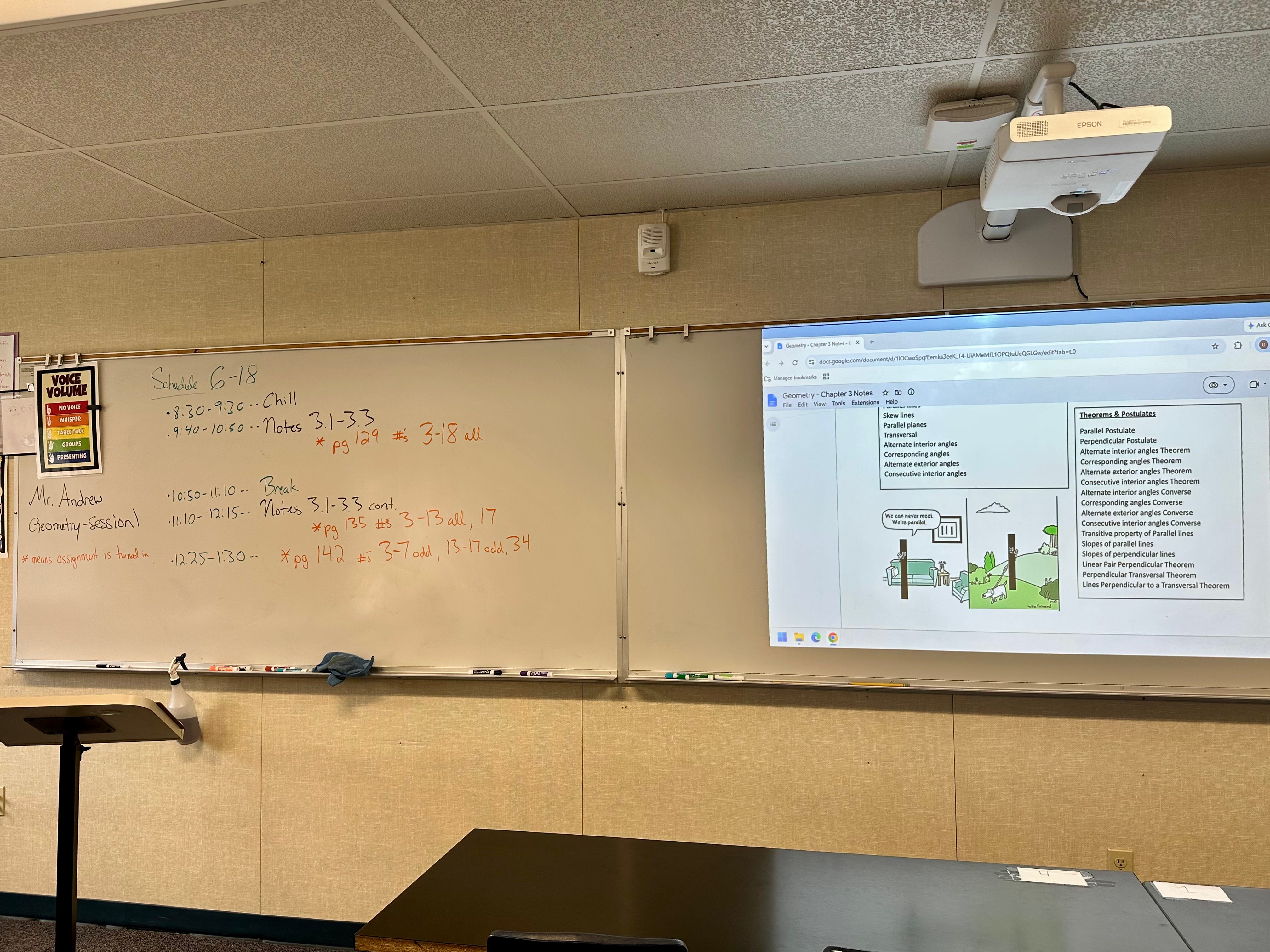
Not Even Robin Yet
Yesterday, in geometry, I was trying to explain why anyone should care about proofs.
Trying to explain proofs to teenagers is a little like trying to explain the spiritual value of flossing. They are not opposed in principle. They simply suspect you have joined a secret society devoted to making their lives worse. Geometry, as far as many of them are concerned, is one of several punishments invented by adults who had access to children and too much free time.
It is harder in summer school. It is harder still when the class runs from 8:30 in the morning until 1:30 in the afternoon, with one twenty-minute break, and everyone knows they are here because they either want to get ahead or they have already failed once and need to pass.
There are eight of them.
Two are trying to get ahead on the road to Calculus. The other six are here because geometry did not go well the first time. Some struggle with the math. Some understand more than they have ever cared to show. Some are bright but work-shy in the way teenage boys can be both, as if the task itself has insulted them by existing.
So I am trying to teach proofs. I have heard, since before and after I took geometry in summer school myself to get ahead, that proofs are many people’s least favorite part of high school.
A proof is strange the first time you meet one. The first time you see one, it can feel less like math and more like somebody making you explain every little thing you thought was obvious. You have a statement. You need a reason. You have another statement. You need another reason. You cannot just say, “Look, it’s obvious.” You cannot just point at the page and hope the page speaks for itself. Geometry will let you see a thing and still ask, “How do you know?”
That question can feel mean.
It can also be the start of wisdom.
So as they pressed me, as students in perpetuity will press their teachers, about the why of proofs, I finally asked them, “Who’s your favorite superhero?”
One said Black Panther, which was a strong answer, and we talked about him for a bit.
Another said Soldier Boy.
I told him Soldier Boy was more of a super-powered character than a superhero, which felt both true and silly enough to keep the room alive. He laughed. Then, when I asked again, he said Homelander.
This did not help his case.
Other names came up. We talked for a minute about powers. Strength. Speed. Flight. Tech. Healing. We were wandering, which is sometimes how a class finds the trail.
Then I said, “My favorite superhero is Batman. And what’s his superpower?”
One student said, right away, “Being rich.”
We all agreed. Of course we agreed. That is part of the answer. A large part of the answer. It turns out it is easier to fight crime when you have a cave, a butler, a jet, and enough money to turn your trauma into military-grade transportation and weapons.
Someone else said gadgets.
Someone else said Alfred, which might be the best answer I hadn’t thought of.
I kept nodding.
Then I asked, “Why do people believe Batman can beat anyone in DC if you give him enough time?”
The room got closer to the point.
Finally, the same student who had been offering characters from The Boys said, “Because he’s the greatest detective. Because he prepares for anything.”
Yes.
There it was.
So I fired back, “Exactly. When Batman has to fight Superman, there is no reason to think Batman has a chance. Superman is Superman. Except Batman will win. Why? Because Batman knows things. Batman plans. Batman studies. Batman has proof the thing is going to work. You all have to become the Batmen of geometry.”
It worked.
Or it worked enough.
Which is often what teaching is.
One of them asked, “Will you give us money if we’re Batman then?”
I said, “No, because you’re not Batman yet. You’re like Batman after his parents died.”
The room groaned, laughed, gasped, and I heard my own words arrive a half-second after they had already left my mouth.
This is one of the gifts and curses of ADHD. The sentence takes the stairs two at a time. The soul catches up later, holding the handrail and whispering, “Maybe not that one.”
So I apologized quickly and tried again.
“You’re like Robin,” I said, “before Robin is even a sidekick. You’re Robin before the mask. You’re in the Batcave, learning what all the tools are, while Batman is out on patrol.”
That one stayed.
Now it comes back when we need it.
Be the Batman of geometry.
Don’t guess. Build the case.
Use the tools.
Find the clue.
Show me why.
I do not think the joke would work if I made it a whole system. They would hate that by break. Middle school and high school students have sharp ears for a bit that has been overmilked. So it stays what it is. A joke that opens a door. I bring it up, then leave it alone. The point is not Batman. The point is proof.
And the point of proof, I keep telling them, is not that I expect them to carry every theorem and property in their heads. I don’t.
I tell them, “I don’t expect you to know all of this. I expect you to have some idea of how to use all of this.”
That seems to lower the fear.
It does not lower the bar.
This is a small class, so no one gets to vanish. In a larger class, a student can become a shadow. Put a Chromebook in front of them, let them sit quietly, and they can look like they’re doing school while slipping out of the room without ever leaving their seat.
We have not opened Chromebooks once. This has more to do with the fact that I did not discover until the day before class began that it was on me to come up with the lesson plan. One day was not enough time to build daily slides too.
So I give them paper. They have textbooks. The work happens in the room, where I can see it. Blank space tells the truth. A pencil that has stopped moving tells the truth. A wrong algebra step tells the truth. A student staring at an angle diagram as though it has betrayed them tells the truth.
And then I can walk over.
I can stop them before the small mistake turns into a whole wrong world. I can ask one question. I can point to one line. I can say, “Look at what they gave you.” I can say, “What kind of angles are those?” I can say, “You know more than you think you know.” I can say, “Nope, try again.” I can say, “You’re almost there.” I can say, “You’re doing the thing.” I can say, “What do you know? And don’t tell me you don’t know anything, I know you know something.”
They are learning.
I would not call it mastery, because it’s not. Mastery is too large a word for three days of proofs. Mastery asks for time. It asks for sleep and return and more mistakes than summer school can hold in one week.
What I am seeing is something closer to a kid wobbling on a bicycle while someone runs alongside with a hand on the seat. They are doing it. They are not doing it alone. And for now, that is enough.
They could not all be left alone with the work and still do it. That is true. It is also not the damning thing some people might think it is. Most of us cannot do the hardest things in our lives when we are left alone with them too soon.
They are understanding because they are not being left alone.
That may be the heart of the whole thing. Maybe, if I think about it, that is what teaching is supposed to be. Not leaving someone alone who isn’t sure they have any idea what they’re being left alone with.
The class is casual. I am sure I am one of the most casual teachers many of them have had. At times, I let them use their phones. I let them listen to music with headphones if it helps them settle and work. They laugh. They chat. Two of the boys who know the material well enough to help others are still teenage boys, which means focus comes and goes like a beach ball bounced around the stands during the seventh-inning stretch. I have to walk over and bring them back.
Yet there are no long fights when I do.
No endless refusals.
No grand campaigns of disrespect.
They drift. I call them back. They come back.
My classroom rules are few.
Honor the worth of others. Meaning don’t be terrible to anyone.
And do the work I ask you to do in class.
That is more or less it.
It does feel loose in the room, especially to anyone who wanders in and wonders if I mixed some circus into the classroom. It feels freer than many classrooms because the rules are few, clear, and weighty. I am not going to spend the whole day waging war over small things just so everyone can be too tired for the real thing. I care about the work. I care about the way they treat one another. I care about the worth of the person in front of them. I care about my own worth in the room too.
One student found the edge of that and I told him, “Don’t piss me off. I don’t like being pissed off, and I promise you won’t like it even more.”
This will not show up in any classroom management textbook, of that I am fairly certain.
Still, he understood me.
There is a kind of student who has been trained to smell weakness in kindness. There is another kind who has learned to hide inside compliance. I am trying to be neither harsh enough for the first to fight nor dull enough for the second to disappear.
I want a room with warmth and teeth.
A room with laughter and work.
A room where the kid who failed because he would not do the work has to do the work, and then finds out he can.
This week, on their second test, three of the boys who had failed geometry before did the kind of work that makes you stop and breathe for a second.
Two earned 100s.
One earned a 98.
Again, I will not call that mastery.
I will call it proof.
Proof that they knew more than their old grade said.
Proof that work avoidance can look like inability from far away.
Proof that a small room with paper and a teacher who keeps circling back can make it harder to disappear.
Proof that some students do not need the work watered down. They need someone close enough to keep handing it back.
And it is not only those three. Two students who struggle more dearly also found their way to A’s, with help, with talk, with the room around them. That matters too. Maybe it matters more.
Because this is what I keep learning: the student who gets it quickly and refuses to work is not the only one in the room. There is also the student who wants to understand and feels lost before the first step. There is the student who is embarrassed to ask. There is the student who has learned to be quiet enough that no one will notice the blank page. There is the one girl in the room, sitting in the midst of all this boy noise and summer restlessness, still doing the work. There is the boy beside her who is in this class mostly because he would not do work, and in another room, with a Chromebook open and his head down, he might have become part of the wall.
Here, he cannot quite become the wall.
I am too near.
The paper is too plain.
The room is too small.
The day is too long.
So we keep going.
We do notes. We do examples. We do practice. We do tests. We go over what went wrong. We learn the names of angle pairs. We use theorems. We write reasons. We move from the picture to the words to the algebra and back again.
And when it gets too heavy, we make a joke.
Sometimes Batman helps.
Tomorrow, I am bringing donuts.
This is not a bribe. The work is already done. This is a small feast before a three-day weekend, before another nine days of summer school, before three more tests, before more proofs and lines and angles and slopes and all the strange little tools geometry asks them to hold and even use.
Five hours of geometry a day is a lot.
Five hours of anything is a lot when you are fifteen and summer is on the other side of the wall.
So we will eat donuts because they have worked, and I saw it.
That is one of the deepest things that this teacher can give, I think.
Not the donut.
The being seen.
I have been thinking about middle school and early high school more than I expected to. Most people who are pulled to teach seem to have an age they love, or at least an age they can bear. Middle schoolers are not always easy to love in the abstract. They are loud and tender and guarded and hilarious. They are old enough to roll their eyes at sincerity and young enough to need it more than they can say. They test every wall and still hope some of the walls hold. They can be mean in the morning and write something beautiful by lunch. They are half child, and half weather system making a meteorologist question everything.
My eighth grade U.S. History teacher, Mr. Fratt, was one of my favorite teachers. He once told the parents at Back to School Night that he loved teaching eighth grade because he thought it was the last chance to truly make a difference in a student’s life. My mom told me that when she got home. I never forgot it.
I do not know if I would say it quite that strongly myself though.
I know we keep changing.
I know high schoolers can still be reached.
I know adults can be reached.
I know I can still be reached.
Thank God for that.
Yet I understand what Mr. Fratt meant in a way I did not understand before. There is a hinge in those years. They are no longer little children. They are not yet the older selves they will soon learn to armor and explain. The door is still open. It may be half-hidden under jokes, moods, sweatshirts, earbuds, and a practiced look of not caring. Still, the door is open.
A few weeks ago, at the middle school where I spent the most time this past school year, a girl told me she had written me a letter and a poem in her English class. The assignment was to write to a favorite teacher.
She chose me.
I had been a substitute there for some long-term teacher absences. Not the full-time teacher. Not the one with my name on the door. Not the one who planned the whole year or graded every essay or knew every family.
Still, she chose me. She had been the student in two of those classes I was the sub for three weeks or more. She really hoped that they would give me her letter and poem because she couldn’t wait for me to read them.
By the end of the day, when I went to turn in the keys and get my timesheet, there were three letters and poems attached to the timesheet.
Three. Her and two other now eighth-grade students who had me as a sub for stretches of their seventh-grade year.
I read them later and let some tears fall gently. Not hard. Not in a way that would have made a scene had I not been alone. Just enough for gladness to find water. As someone who uses words, the words of those three kids moved me.
Then, the other day, someone from a church I once served sent me a text. She had heard from a man connected to that church, whose son is going to that same middle school next year, that some students had had me as a sub and wished I could be with them full time. The son hoped he would get to have me next year too.
It came through a grapevine so odd and sweet I could not have planned it if I tried.
Someone heard from someone who heard from someone that students hoped I would show up. Students other subs have run away from. Which I know, because they would tell me when “we made the sub quit after our period Mr. Andrew. They should just send you anyway.”
That is a strange gift when you are learning a new life.
I do not want to make it too neat. I do not want to turn a few good days, some kind words, and a small summer geometry class into a grand claim about destiny. I have lived long enough to distrust the tidy bow anyone tries to give life.
Still, I am trying to pay attention.
I spent years in a life where words mattered. Sermons. Prayers. Blessings. Bedside whispers. Public speeches. Old stories told in such a way that people might hear their own lives inside them.
Now I find myself in a classroom with eight students, a stack of paper, a textbook, and a roomful of angles.
And I am still trying to help people see.
Only now the question is sometimes, “How do you know these two angles are congruent?”
Sometimes it is, “What did the diagram give you?”
Sometimes it is, “What reason belongs in the right-hand column?”
Sometimes it is, “Can you stay with this a little longer than you thought you could?”
Maybe that last question has been for me too.
I told them proofs are how you build trust in what you claim. You look at what has been given. You name what you know. You use the tools you have. You move one step at a time until the thing you hoped was true can stand.
Then life, with a kind of mercy I did not ask for and could not have earned, began handing me small proofs.
A joke that worked.
A class that stayed with the work.
A boy, who would rather not try, earning a 100% on a test when he did.
A girl choosing me as a favorite teacher.
Three letters on a timesheet, letting me know she was not alone in that choice.
A text from someone who heard that students wished I could be there full time.
Donuts waiting for the morning.
None of this proves everything.
It proves enough for today.
And maybe that is what I am learning to love about teaching. You rarely get the whole proof at once. You get a line. Then another. A reason. A clue. A kid who looks up. A page that is no longer blank. A laugh that loosens the room. A student who comes back to the work after drifting away.
For now, that is enough.
For now, I will keep walking the room.
I will keep telling them to be the Batman of geometry.
I will keep reminding them that they do not have to know every tool by heart. They have to learn how to use what they have when they find it.
And somewhere in the Batcave, before the mask, before the cape, before anyone is ready, we will keep doing the work.
I do like this teaching thing.
A small note before you go:
This little room of words I share when I can keeps going because people read, share, write back, and help carry it. When a piece like this stirs something in you, some old classroom, some teacher, some kid who needed someone close by, I’d love if you considered sharing it.
Passing it along, joining as a subscriber, or leaving a one-time gift all help keep this work alive.
Thank you for being here.
The line that got me after writing this is: “They are understanding because they are not being left alone.”
I think that is true of geometry, and high school, and grief, and new life, and most of what is hardest for us.
So much of what saves us is someone close enough to say, “You know something. Start there.”
You are a natural teacher and I urge you to stick with it if it’s beginning to resonate with you. We need more teachers who care about the kids. Especially those who are Jr. High and at the bottom of the group due primarily to either previous gaps in schooling or lack of motivation. Much of the solution is getting them to believe in themselves and that is where you shine. Sadly the problem is that onerous year of teacher training. I primarily taught 11AP English which satisfied my love of lesson planning and 9 General English where I really taught rather than coached. You continue to serve in love!