
Given: Light
Reason: Sometimes grace sits across from you and asks, “What do you know?”

Given: Light
Reason: Sometimes grace sits across from you and asks, “What do you know?”
For most of the first forty-five years of my life, early Sunday morning meant getting ready for church.
Not always gladly. Not always peacefully. But usually.
There was a sermon somewhere in the room, finished or unfinished. There was a shirt that needed to look like I had tried to iron it. There were prayers to gather, announcements to remember, names to hold, rooms to enter, people to greet, and some version of myself I had to put on before I walked through the doors.
That last part mattered to people, I found.
They did not always want me to be me. They needed me to be their idea of a pastor. Their ideas rarely fit me well.
This Sunday morning, months away from forty-six, I applied to a teaching credential program.
No pulpit. No stole. No bulletin. No sanctuary waiting.
Just a form on a screen, a future I did not see coming, and the strange quiet of a life beginning again.
I have not written here for ten days, which feels longer to me than it probably does to anyone else. Ten days on Substack can feel like an eternity to the writer, especially when the writer has just begun to believe again that writing might be part of how he stays alive.
But I have not been gone.
I have been teaching geometry summer school six hours a day. I have been relearning the things I am supposed to teach before I teach them. I have been making notes, writing tests, building practice tests, checking answers, fixing diagrams, explaining proofs, and trying to stay at least one good step ahead of the room.
In other words, I have been doing on the fly what the credential program is supposed to teach me how to do on purpose.
Which feels about right.
A year of my life has gone that way. First the vocational ending, then the upheaval, then the injury, then the moving, then the new house, then the new school rooms, then the strange grace of finding myself alive in places I had not planned to be.
I did not choose most of the road that brought me here.
An unwanted eviction notice helped bring us here. An unwanted injury helped bring us here. A deep loss of safety in the old vocational world helped bring us here. A life I knew how to explain, even when I did not know how to survive it, began to crumble in ways I could not control.
And somehow, through all of that, Melinda and I now live about a hundred yards from this view.
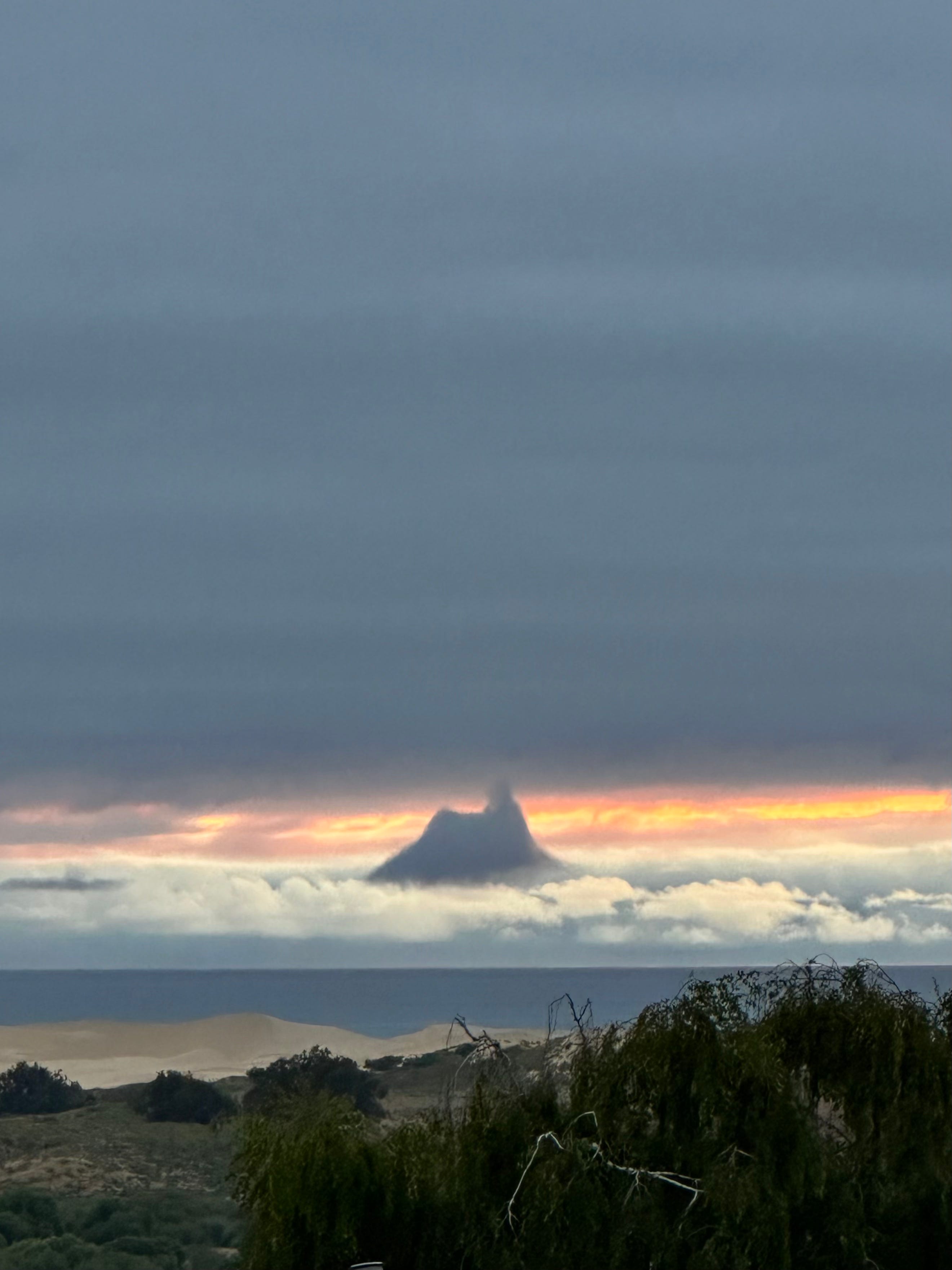
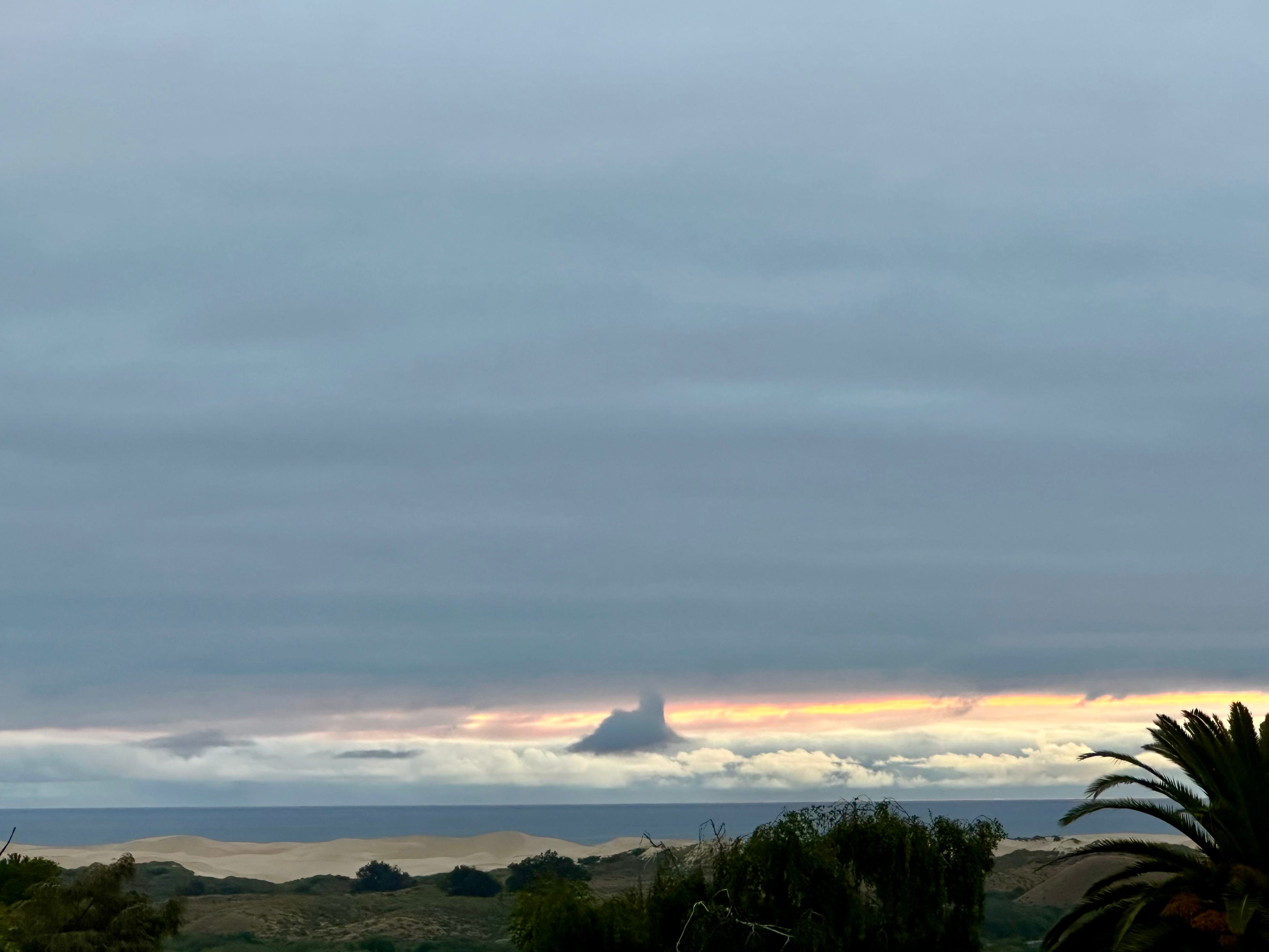
Last week, or maybe two weeks ago now, we were on an evening walk when the sky opened in that strange way the coast sometimes does. The clouds stayed. The dark stayed. The weather stayed.
But there was light anyway.
There was a strip of fire at the horizon, and the ocean under it, and the dunes, and the shape of something rising out of the clouds like a mountain, or a wound, or a prayer that had not yet decided what it wanted to be.
We stood there looking at it because what else do you do?
Melinda and I keep saying some version of the same thing to each other.
Can you believe we live here?
Can you believe this is our neighborhood?
Can you believe the simplicity and shoreline combination we used to dream about, but never really believed could happen, has somehow happened?
It is a strange thing to receive a gift that came wrapped in grief.
I do not want to make it too clean. I do not want to pretend the eviction notice was good, or the injury was good, or the vocational wreckage was good. I do not want to baptize every hard thing just because something beautiful grew near it.
Some things are simply hard.
Some things hurt.
Some things are lost and do not come back.
But I am beginning to wonder if holiness has a way of making mosaics without asking the broken pieces to stop being broken. Maybe grace does not erase the rubble. Maybe it teaches some of it how to become foundation.
That is what this year has felt like.
Rubble learning to bear weight.
Broken pieces catching light.
Which brings me back to Jesus.
“You are the light of the world.”
He says it with no hint of jest.
Not, you will be light someday if you behave. Not, you can become light if the right people approve of you. Not, you may qualify for light after enough improvement, enough repentance, enough shame, enough institutional usefulness.
You are the light of the world.
That line has been following me around my whole life.
It followed me out of the church world I knew. It followed me into classrooms where students call me Mr. Andrew instead of Pastor Garrett. It followed me into a smaller house near the water. It followed me into the strange ache of no longer being who I was, while also not yet knowing who I am becoming.
It followed me onto that evening walk with Melinda, while the sky was doing its coastal sermon without asking anyone if they wanted a sermon.
And it has followed me into geometry summer school.
In the middle of this, I have been teaching students who are taking geometry again.
That sentence can sound small unless you have sat with a teenager who already believes the subject has judged him.
There are students who walk into summer school carrying more than a backpack. They carry the memory of the last test, the last class, the last time they felt stupid in front of a page. They carry whatever story they have already been told about themselves, or maybe the story they have started telling themselves because nobody interrupted it soon enough.
I know that story.
I know what it is to look at a page and think, I cannot do this.
One of my students got a 90 on his second test. Afterward, I heard him say to a friend, almost like he was trying the sentence out to see if it was allowed, “This is my first A on a math test ever.”
The next test he got a 97.7.
He told me he wanted to show it to his mother.
The test after that, which he took on Friday, he got 100.
I asked him what that felt like.
At first, he did not know what to say. Which made sense. Sometimes joy takes a second to find language, especially when it has spent years being cautious.
Then he said, “Mr. Andrew, you’re the first teacher I’ve ever had who will sit in front of me during a test and keep asking me what I know, and force me to remember, and help me when I think I don’t know anything.”
I think that was his way of saying I refuse to give up on him.
He will look at a problem and say, “I can’t do this.”
And I will say, probably too quickly, because patience is not always my most natural virtue, “Stop saying that. I know you can. What do you know here?”
Not, what do you not know?
Not, why are you stuck?
Not, how did you forget this again?
What do you know?
Because almost always, he knows something.
He knows that two angles are congruent. He knows that parallel lines make certain angles match. He knows the triangle has 180 degrees in it somewhere. He knows the slope formula is hiding in the room even if he does not want to look at it directly.
And once he says what he knows, the next step has a chance to appear.
I am trying to learn that this is not only a way to teach geometry.
It may also be a way to survive.
I have spent much of this year looking at the page of my own life and saying some version of, I can’t do this.
I can’t begin again.
I can’t become someone else this late.
I can’t lose the life I had and still trust the life that is coming.
I can’t stand in front of students and teach them proofs when I am still trying to prove to myself that I am not finished.
And over and over again, in ways I would not have chosen and cannot fully explain, the Divine Whisper has sat across from me and asked,
What do you know?
Not what do you fear.
Not what did you lose.
Not what can you no longer call yourself.
What do you know?
I know my wife and I can walk a hundred yards from our house and see the sky burn over the water.
I know my children still have their friends, their humor, their kindness, their brilliance, their own unfolding lives. My son is in the summer before his senior year, with college applications coming toward us like headlights. My daughter is living the full and appropriate drama of being fourteen and nearly fifteen, depending on the day and the weather inside her soul.
I know students who failed geometry are getting A’s.
I know one of them looked at a test and saw something other than doom.
I know I applied to a credential program on an early Sunday morning, and no lightning struck me for not being in church.
I know I was never the right kind of clergy for every room I was in. Too loud for some. Too emotional for others. Too rational for the mystical ones. Too mystical for the rational ones. Too much for people who preferred less. Too sinful for people who needed the pastor to make their theology work.
And still, beneath all of that, before all of that, after all of that, I know this:
God delights in me.
I do not always know what to do with that.
But I know it.
A friend recently shared a line from Frithjof Schuon, a thinker he introduced me to and one I have come to appreciate too: “It is not the intellect which penetrates God, but God who penetrates the intellect; no one can choose God who has not been chosen by Him.”
I do not know that I would say it exactly that way.
I stumble over some of the language.
But I recognize the truth hiding there. God is not an idea I figured out. God is not the prize at the end of my best thinking. God is the One who keeps getting through to me, around me, beneath me, sometimes in spite of me.
Sometimes through a student.
Sometimes through my wife’s face on an evening walk.
Sometimes through a sky so strange and beautiful it feels like it is trying to tell the truth without words.
Sometimes through the memory of Jesus saying something I still find almost impossible to believe.
You are the light of the world.
Many of us have a hard time believing that.
I know I do.
We have been taught, in thousands of ways, to treat light like a reward. Be good enough, and maybe you will shine. Be useful enough, and maybe you will matter. Be clean enough, holy enough, productive enough, successful enough, desirable enough, agreeable enough, and maybe the world will let you glow a little.
But Jesus does not seem interested in making light a prize.
He says it as a fact.
You are the light of the world.
Which means the light was there before the title.
Before the office.
Before the pulpit.
Before the fall.
Before the test score.
Before the credential application.
Before the new house.
Before the old life broke.
Before anyone knew what to do with me.
That is the part I keep returning to. The light was not given to me because I became impressive. The light was not taken from me when I became inconvenient. The light is not waiting for me at the far end of proving myself.
It is given.
Given: light.
Reason: Jesus said so.
And maybe the work of a life is not to become light, but to stop hiding from the light that has already been placed within us.
To delight in creation.
To let ourselves be delighted in.
To bear witness to the light in one another before the darkness gets the last word.
I like that word, delight.
I am fairly sure it has no real etymological connection to light, but I hear the light in it anyway. Delight. The word itself feels like a lamp being uncovered. To delight is to be pleased, charmed, allured, drawn out of yourself by beauty. It is what happens when the soul stops clenching for half a second and notices that the world is still shimmering.
And maybe that is part of what Jesus meant.
Maybe light is not only moral purity or spiritual achievement or whatever anxious religious people have sometimes made it.
Maybe light is also the way a student’s face changes when he realizes he knows more than he thought.
Maybe light is my wife and me laughing like children because we somehow live near the ocean now.
Maybe light is my son on the edge of senior year, my daughter in all her brilliant teenage weather, both of them still becoming themselves.
Maybe light is a classroom full of students trying again.
Maybe light is a credential application submitted on a Sunday morning.
Maybe light is the strange mercy of not being done.
The old life is not coming back.
I think I know that now.
Some days I grieve that. Some days I feel free. Most days it is both, and I am learning to stop demanding that my soul pick only one feeling at a time.
But here is what I know.
The clouds stayed.
The dark stayed.
The weather stayed.
And there was light anyway.
A student says, “I can’t do this.”
A teacher says, “What do you know?”
A man who thought one life was ending opens an application on an early Sunday morning.
A wife and husband walk a hundred yards from their new home and see the sky burning over the water.
And somewhere in all of it, the One Jesus called Abba keeps whispering the same impossible thing:
You are the light of the world.
Not someday.
Now.
Thank you for reading this.
If these words met you somewhere true, I’d be grateful if you shared them with someone who may need to be reminded that the light has not left them either.
And if you’d like to stay close to this work, you can subscribe, leave a comment, or offer a one-time gift to help me keep writing as this new life keeps unfolding.
However you are here, I’m glad you are.
Given: light.
Reason: somehow, still, we keep finding one another in it.
Asking "what do you know?" is a question that goes far beyond the math classroom. If you're willing to share, what is one true thing you know about your life right now, even if the rest of the page feels uncertain?
The Reverend Cecil B. Williams once said. "Your life is critical at this time." He said it to the most disparate room full of people I had ever seen. I share this sentence with you now because it is true. Your life is critical at this time. You are and we all are the Lights of the World.